Blue Heeler full grown

A full grown Blue Heeler weighs 35 to 50 pounds. Males stand 18 to 20 inches at the shoulder and females 17 to 19 inches. Blue Heeler is the common name for the Australian Cattle Dog, which is how the AKC lists the breed.

full grown, across every size
35 to 50 lbfull grown, across every size
at the shoulder
17 to 20 inat the shoulder
before growth slows to a crawl
11 monthsbefore growth slows to a crawl

Blue Heeler weight calculator

Answers update as you move the sliders.

Age unit
Weight unit
Expected adult size

Large: 33 to 66 lb as an adult.

SexOptional

Likely adult weight

42lb

8 in 10 land between
34 to 55 lb
Fully grown
around 11 months

Size class: Large, 33 to 66 lb

2Now4681012Adult
Age in monthsSo farProjected

Fair. Four to five months is the usual time to make this estimate. It is reasonable now, but the range is still wide.

Estimate only. For health questions, ask your vet. Mixed breeds can land outside the range.

See the expected weight month by month
AgeLikely weightRange
2 months8.2 lb4.5 to 14.8 lb
3 months13.3 lb7.8 to 23 lb
4 months19.3 lb12 to 31 lb
5 months25 lb15.9 to 39 lb
6 months30 lb19.3 to 45 lb
7 months33 lb22 to 50 lb
8 months36 lb24 to 53 lb
9 months37 lb26 to 54 lb
10 months38 lb27 to 56 lb
11 months39 lb27 to 56 lb
12 months40 lb28 to 57 lb
13 months40 lb28 to 57 lb
14 months41 lb29 to 57 lb
15 months41 lb29 to 57 lb
16 months41 lb30 to 57 lb
17 months41 lb30 to 57 lb
18 months42 lb32 to 57 lb

Scroll the table sideways to see every column.
Expected weight month by month, from the same estimate.

In short

Key takeaways

  1. A full grown Blue Heeler weighs 35 to 50 lb across all its sizes.
  2. The weight and height here come from the official breed standard.
  3. Most of the growing is done by about 11 months.
  4. A double coat means regular paid grooming, which is a real yearly cost.
  5. The chart below shows a band, not a line, because individual dogs vary.

Adult size

Adult size and growth chart

Australian Cattle Dog

Large size class · Category IV (15 to under 30 kg)

Breed standard
adult weight
35 to 50 lbadult weight
height at the shoulder
17 to 20 inheight at the shoulder
most growing done by
11 monthsmost growing done by
WeightHeight at the shoulder
MaleNot stated18 to 20 in
FemaleNot stated17 to 19 in

Scroll the table sideways to see every column.

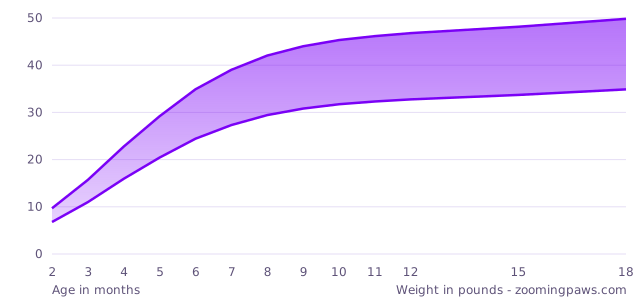
Australian Cattle Dog growth chart. Weight runs from about 7 to 10 pounds at 2 months, up to about 35 to 50 pounds at 18 months, for a full grown Blue Heeler.
Estimated from the adult weight range above and the growth standard for the large size class. The band runs from the low end of the adult range to the high end.
See the Australian Cattle Dog weight by age as a table
AgeLow endHigh end
2 months6.8 lb9.7 lb
3 months11 lb15.7 lb
4 months15.9 lb22.8 lb
5 months20.4 lb29.2 lb
6 months24.4 lb34.9 lb
7 months27.3 lb39 lb
8 months29.4 lb42 lb
9 months30.8 lb44 lb
10 months31.7 lb45.3 lb
11 months32.3 lb46.2 lb
12 months32.8 lb46.8 lb
15 months33.7 lb48.1 lb
18 months34.9 lb49.8 lb

Scroll the table sideways to see every column.

Timing

When a Blue Heeler stops growing

In our figures, a dog in the large size class has done almost all of its weight gain by about 11 months. After that the weekly gain drops below a quarter of a percent of adult weight, which is slow enough that you will not see it on the scales week to week.

Height finishes earlier than weight. The AKC puts small breeds at full size by 6 to 8 months, medium breeds at around 12 months, and giant breeds at 12 to 18 months, with some very large breeds taking up to 24.

11 months

before weekly weight gain drops below a quarter of a percent of adult weight

Sex

Male and female

The breed standard gives different figures for males and females, and they are in the tables above. In the growth data behind our calculator, a female of a given size class is also slightly further along toward her adult weight at any given age than a male, so telling the calculator which you have shifts the estimate by a few percent.

Variation

Why individual Blue Heelers differ

Blue Heeler and Red Heeler are coat colors of the same breed, the Australian Cattle Dog. Color has nothing to do with adult size.

This is a dense, muscular working dog. At 35 to 50 pounds on a 17 to 20 inch frame, a Heeler is heavier than it looks.

Puppies are born white and darken over the first weeks, which has no bearing on size but surprises a lot of new owners.

Running cost

Grooming a Blue Heeler

A double coat is a running cost, and it is worth knowing the figure before you take a puppy home rather than after. The price per groom goes up with the size of the dog.

Work out the cost

FAQ

Questions people ask

How big is a Blue Heeler full grown?
35 to 50 pounds across every size this breed comes in, standing 17 to 20 inches at the shoulder. Those figures come from the breed standard.
How can I tell how big my Blue Heeler puppy will get?
Weigh your puppy and enter its age in the calculator on this page. It is already set to the large growth curve for this breed, so it works backwards from where your puppy is now rather than from the breed average. Four to six months is when the estimate is most reliable.
How often does a Blue Heeler need grooming?
A double coat needs a groom every 4 to 8 weeks under published guidance. Over a year that adds up, and the grooming cost estimator works out what it comes to for a dog this size.
When does a Blue Heeler stop growing?
Weight gain slows to almost nothing at around 11 months for a dog in the large size class. Height finishes earlier than weight in every breed.
How big does a Blue Heeler get?
35 to 50 pounds, at 18 to 20 inches for a male and 17 to 19 for a female. That is the AKC Australian Cattle Dog standard.
Is a Blue Heeler the same as an Australian Cattle Dog?
Yes. Blue Heeler is the common name for the blue-coated Australian Cattle Dog. The red-coated version is called a Red Heeler. Same breed, same standard.
When is a Blue Heeler full grown?
About eleven months for weight in our figures, with the chest filling out for a few months after that.

Method

How we calculate this

The adult weight and height come from the sources below. The shape of the growth chart comes from our own calculation on the open data behind a published veterinary growth standard, described on the how we calculate page. The charts are estimates built from a breed range and a population curve, not measurements of this breed.

Sources

4 sources behind the figures on this page.

  • Australian Cattle Dog breed standard

    American Kennel Club - read 2026-10-08

    akc.org
  • Growth standard charts for monitoring bodyweight in dogs of different sizes

    Salt C, Morris PJ, German AJ, Wilson D, Lund EM, Cole TJ, Butterwick RF. PLoS ONE 12(9):e0182064 - dated 2017-09-06 - read 2026-10-08

    Open access. Sets the adult-size categories and the growth standard method.

    pmc.ncbi.nlm.nih.gov
  • Growth standard charts for monitoring bodyweight in dogs of different sizes - supporting data

    University of Liverpool Data Catalogue - dated 2017-07-28 - read 2026-10-08

    14,957,947 weight records from Banfield Pet Hospitals, 1994-2013, released under CC BY 4.0. Our growth curves are calculated from this file.

    datacat.liverpool.ac.uk
  • When Does My Puppy Finish Growing?

    American Kennel Club - read 2026-10-08

    akc.org

Nearby

Keep going

Last reviewed . Estimate only. For health questions, ask your vet.