How many puppies are born in the US each year? What the data can and cannot tell us
There is no official count of puppies born in the US; the closest figure we can build is a model estimate of about 1.96 million (range 1.27 million to 3.48 million) Estimated[5][7][12][13] dogs bought from breeders each year.
1.96 million
Range 1.27 million to 3.48 million
dogs bought from US breeders per year (model, central estimate)
A model, not a count of puppies born: there is no official national puppy-birth count, and the acquisition-rate bounds come from a 1996 household survey.
Calculated from Humane World for Animals [5] and New et al. 2004 [7] and APPA [12] and Purdue Extension, citing APPA [13]
441,126
dogs registered with the American Kennel Club
Voluntary purebred registrations, not puppies born.
Source: American Kennel Club [1]
2,163
active USDA Class A breeder licences on 2026-10-21
Covers breeders of every regulated species; many dog breeders need no USDA licence.
Source: USDA APHIS [2]
A model, not a count of puppies born: there is no official national puppy-birth count, and the acquisition-rate bounds come from a 1996 household survey. What is counted is narrower: AKC registrations and USDA breeder licences. Surveys show where owners get their dogs.
Published Last reviewed Next scheduled review
In short
Key takeaways
- There is no national count of puppy births. Every total you see is an estimate or a partial count.
- Our model estimate: about 1.96 million (range 1.27 million to 3.48 million) Estimated[5][7][12][13] dogs a year bought from breeders. A model, not a count of puppies born: there is no official national puppy-birth count, and the acquisition-rate bounds come from a 1996 household survey.
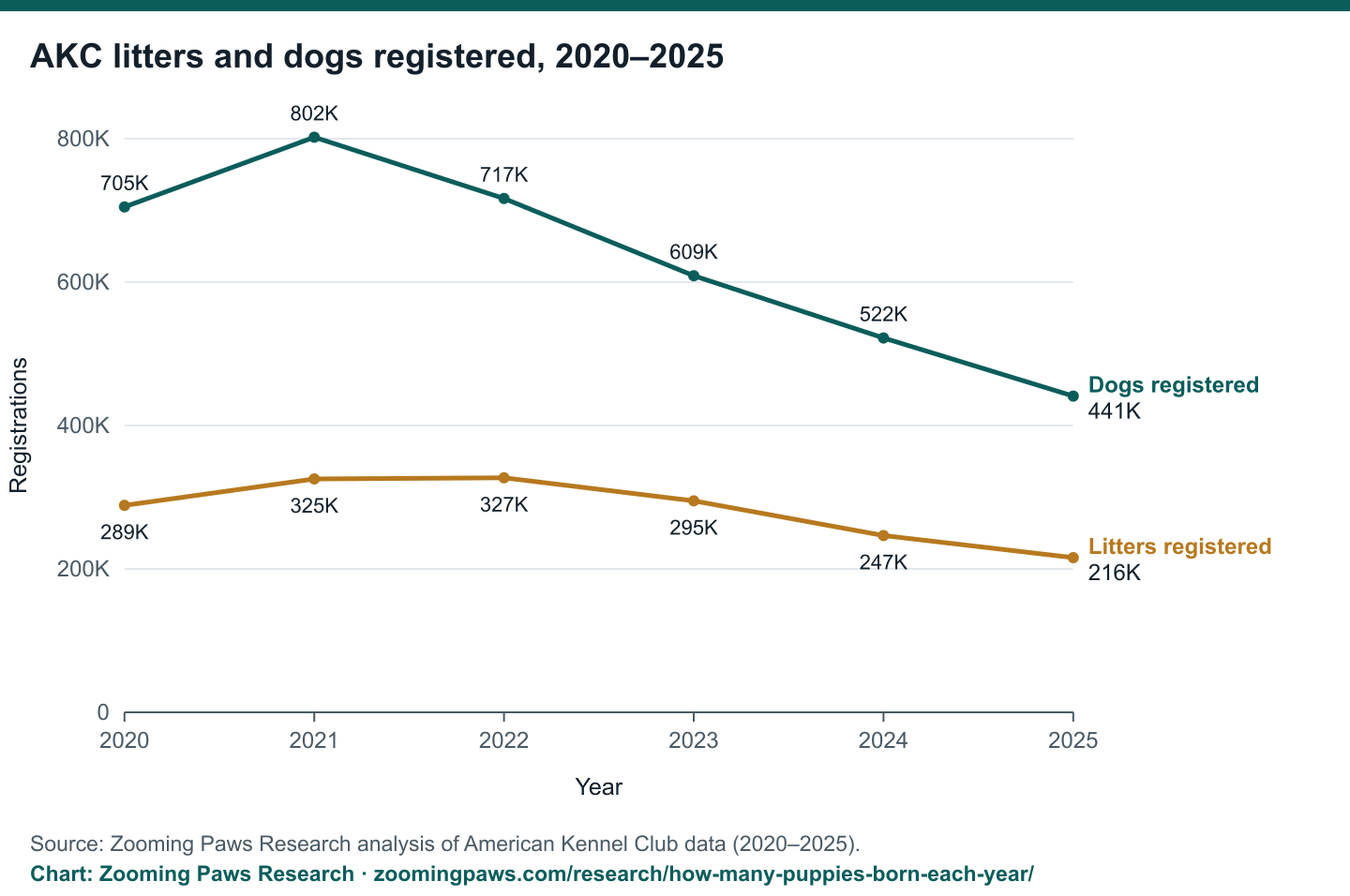
- AKC registered 441,126 Counted[1] dogs in 2025, down from 704,833 Counted[1] in 2020.
- Active USDA Class A breeder licences fell from 3,014 Counted[2] to 2,163 Counted[2] between 2020 and 2026.
- Surveys put the share of dogs from breeders between 18.4% Surveyed[5] and 34% Surveyed[13].
- Humane World for Animals estimates about 2.0 million Estimated[3] puppies a year are sold from puppy mills, without a published method.
Explore the data
Build the estimate yourself
Move each slider within the range the sources publish. The answer updates as you go, and each slider shows where its limits come from.
Estimate builder
Dogs bought from breeders each year = dogs in US homes × share acquired each year × share bought from a breeder.
Starts at 88.5 million: the midpoint of the two sourced values (our assumption) [5][12]
Starts at 9.7%: the midpoint of the two sourced values (our assumption) [7]
Dogs bought from breeders per year
1.96 million
Full range from the sources: 1.27 million to 3.48 million.
EstimatedEstimated: your assumptions within published ranges. A model, not a count of puppies born: there is no official national puppy-birth count, and the acquisition-rate bounds come from a 1996 household survey.
Charts
The data in charts
Every chart can be downloaded as a PNG or as the CSV behind it, and embedded with a credit link.
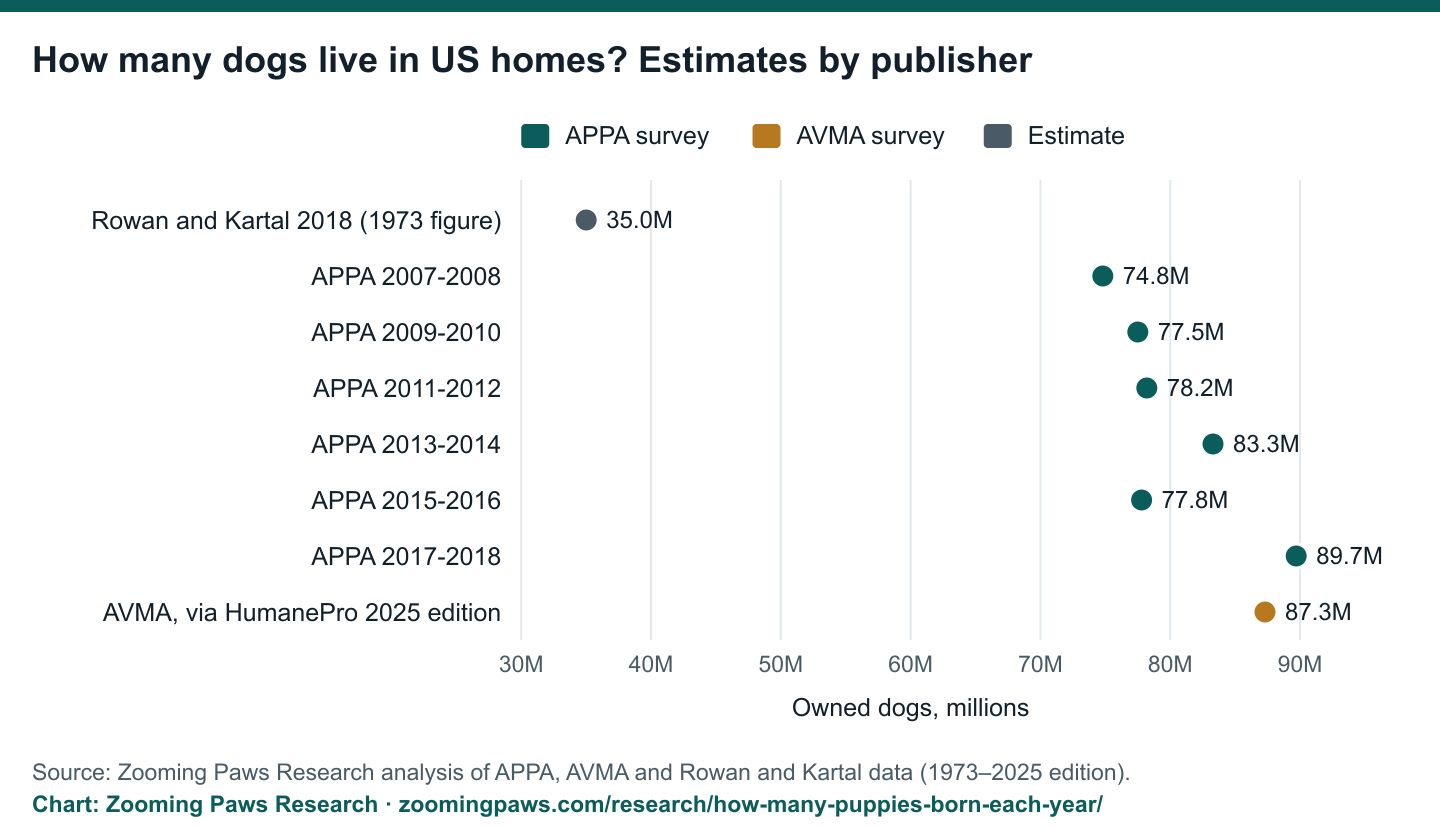
How many dogs live in US homes? Estimates by publisher
Surveys differ in method and in what they count as a household dog, so editions from different publishers are not a trend. APPA has not published a dog count on its public pages since its 2017–18 edition.
Source: Zooming Paws Research analysis of APPA, AVMA and Rowan and Kartal data (1973–2025 edition).
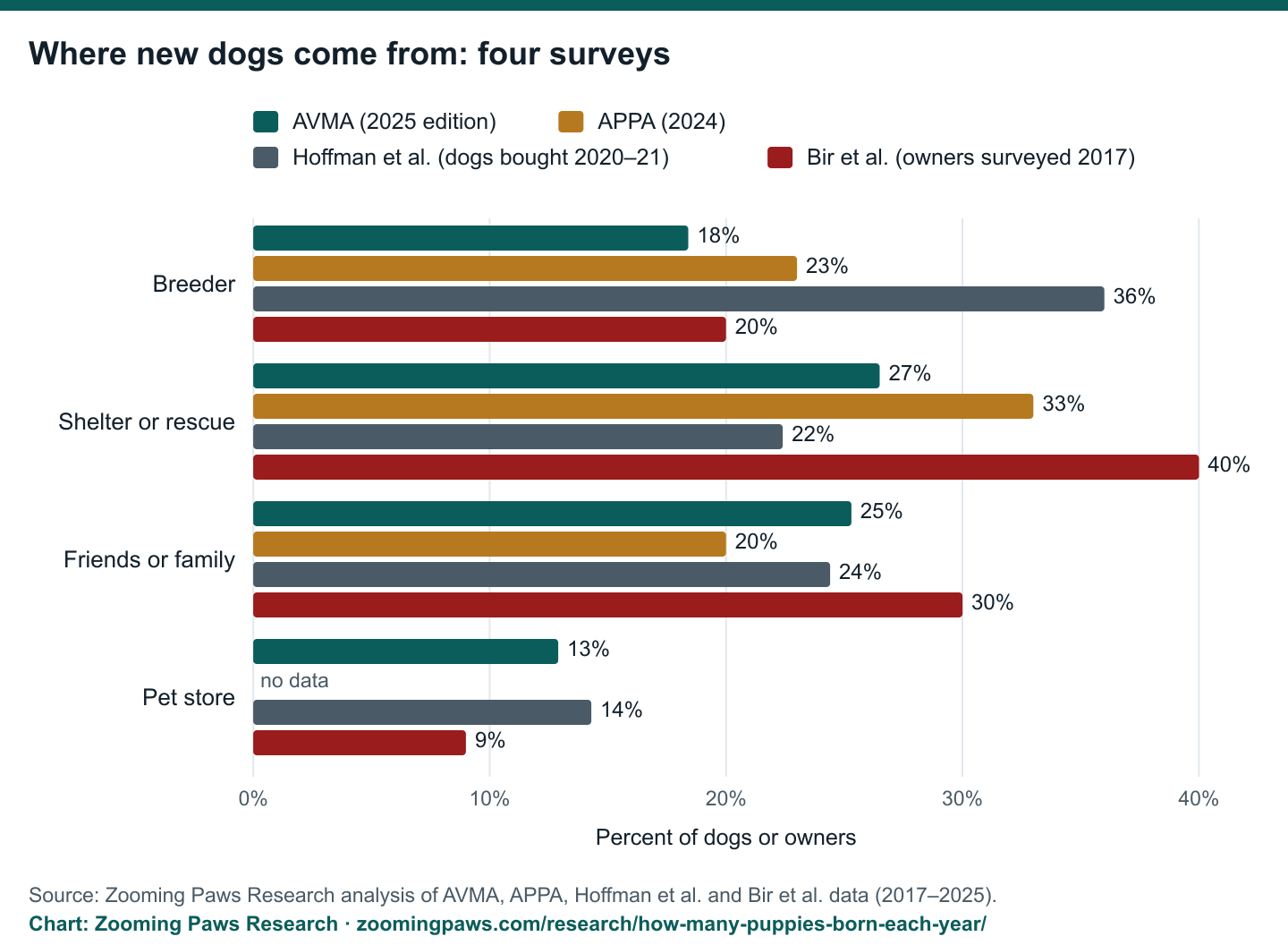
Where new dogs come from: four surveys
Each survey asks a different question: AVMA and APPA cover dogs owned, Hoffman et al. dogs bought during the pandemic, Bir et al. owners (who could tick more than one source). Where a survey splits a category (shelter and rescue, independent and chain store), we add the parts.
Source: Zooming Paws Research analysis of AVMA, APPA, Hoffman et al. and Bir et al. data (2017–2025).
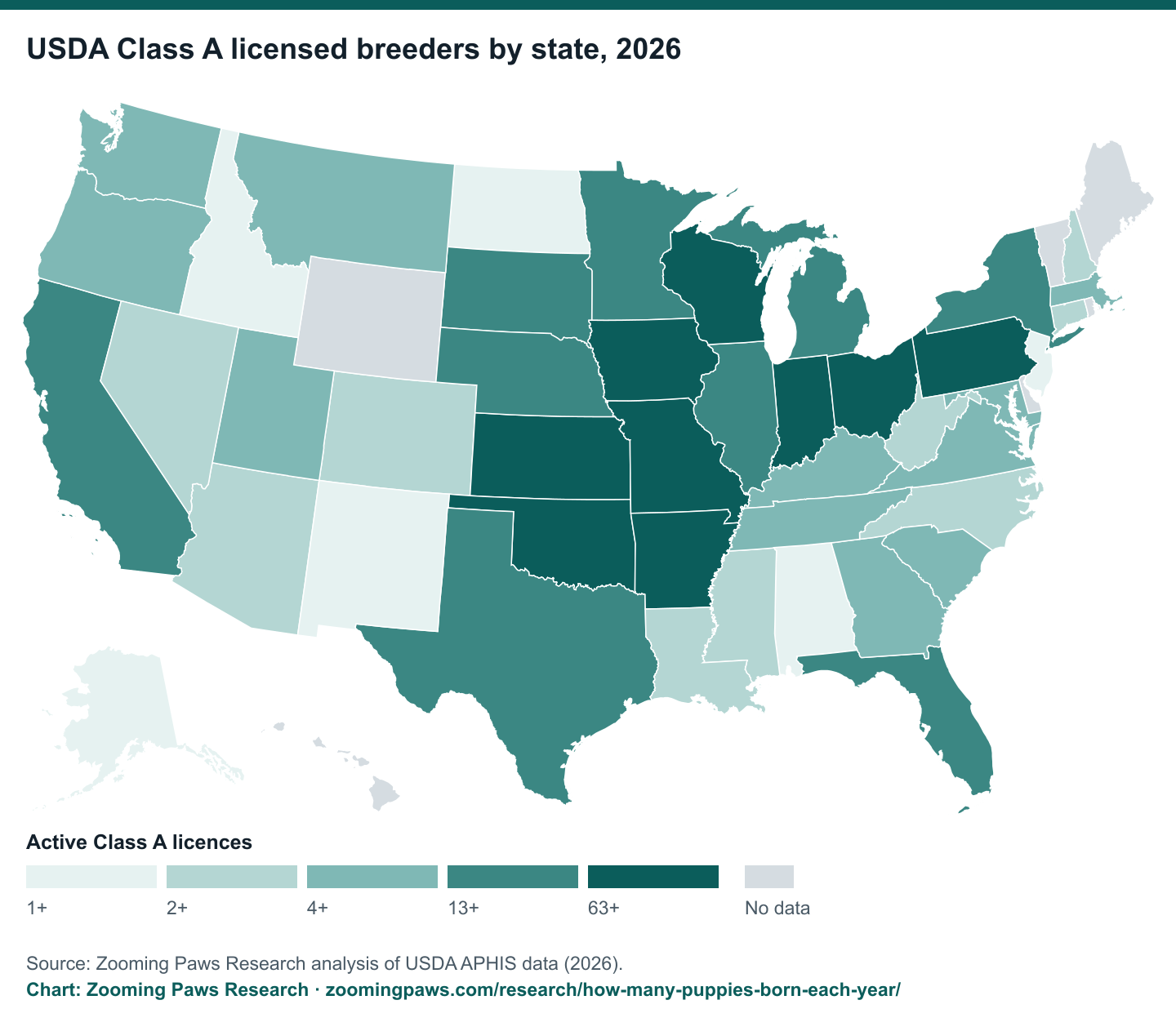
USDA Class A licensed breeders by state, 2026
Grey states had no active Class A licence on the list. Many breeders need no USDA licence (for example those selling directly to the public), so this is not a count of all breeders.
Source: Zooming Paws Research analysis of USDA APHIS data (2026).
AKC litters and dogs registered, 2020–2025
Only purebred dogs whose breeders choose to register them. Registration is voluntary, so these count registrations, not puppies born, and leave out every puppy that is never registered.
Source: Zooming Paws Research analysis of American Kennel Club data (2020–2025).
Why nobody counts puppy births
No US agency registers dog births. The federal licence list covers only breeders that fall under the Animal Welfare Act, and breed registries record only the litters their members choose to register. Puppies born outside both are not recorded anywhere we could find.
The best direct measure is old: a national household survey found 11.4 Surveyed[7] puppies born per hundred household dogs in 1996. Rowan and Kartal’s review of US dog population trends publishes no current births estimate either.
What is counted: AKC registrations and USDA licences
The American Kennel Club published 215,709 Counted[1] litters and 441,126 Counted[1] dogs registered in 2025. Registrations have fallen every year since 2021. We could not find AKC totals for earlier years in any public document.
The USDA’s public licence list showed 2,163 Counted[2] active Class A breeder licences on 2026-10-21. We counted the rows ourselves, by state, from the list files. Class A covers breeders of every species the law regulates, so it is an upper bound on licensed dog breeders.
What is surveyed: where owners get their dogs
Surveys ask owners where their dog came from. AVMA’s latest edition puts breeders at 18.4% Surveyed[5], APPA’s 2024 survey at 23% Surveyed[5] and APPA’s 2014 survey at 34% Surveyed[13]. Among dogs bought during the pandemic, 36% Surveyed[8] came from breeders.
These shares describe the dogs people own or bought, not puppies born. Most surveys list pet stores separately from breeders; APPA’s 2017 to 2018 edition combined them, so it is not used for the breeder share.
What is modelled: published estimates
Humane World for Animals estimates at least 10,000 Estimated[3] puppy mills and about 2.0 million Estimated[3] puppies sold from them each year, and that USDA-licensed breeders produced 694,757 Estimated[4] puppies in 2025. It does not publish how the first two figures were made.
Published US dog population estimates run from 87.3 million Surveyed[5] to 89.7 million Surveyed[12], from surveys taken years apart with different methods.
Our transparent estimate
Dogs bought from breeders each year = dogs in US homes × share of dogs acquired each year × share of new dogs bought from a breeder.
- Dogs in US homes: 87.3 million Surveyed[5] (AVMA, via HumanePro, 2025 edition) to 89.7 million Surveyed[12] (APPA, 2017-2018); central value the midpoint.
- Share acquired each year: no source publishes this. The nearest bounds are the household survey’s 7.9 Surveyed[7] dog deaths per hundred dogs (the dogs that must be replaced to keep numbers steady) and 11.4 Surveyed[7] puppies born per hundred dogs; central value the midpoint.
- Share bought from a breeder: 18.4% Surveyed[5] (AVMA, via HumanePro, 2025 edition), 23% Surveyed[5] (APPA, 2024) and 34% Surveyed[13] (APPA, 2014). Pet stores are left out.
Result: 1.96 million (range 1.27 million to 3.48 million) Estimated[5][7][12][13]. This is a model estimate of dogs bought from breeders, not puppies born, and there is no official national puppy-birth count to check it against. It leaves out puppies kept, given away or sold in pet stores, and its acquisition-rate bounds rest on a 1996 household survey.
How to cite these figures responsibly
- Say “estimated” and give the range, not just the central figure.
- Name the publisher behind each number: AKC and USDA figures are counts, survey shares are surveys, everything else is a model.
- Do not add AKC registrations to USDA licensees or survey shares: they overlap and measure different things.
- Do not compare dog population figures from different publishers as if they were a trend.
Data
The estimate, factor by factor
Each input with its low, central and high value and source, the result, and the published figures we cross-checked it against.
| Cross-check: AKC dogs registered | count | 441,126.0 | registrations | 2025 | Counted |
| Cross-check: AKC litters registered | count | 215,709.0 | registrations | 2025 | Counted |
| Cross-check: puppies produced by USDA-licensed breeders | publisher figure | 694,757.0 | count | 2025 | Estimated |
| Cross-check: puppies sold from puppy mills per year | publisher figure | 2,000,000.0 | count | 2026 | Estimated |
| Factor: Dogs acquired per year, per 100 dogs | low | 7.9 | per 100 dogs in households | 1996 | Surveyed |
| Factor: Dogs acquired per year, per 100 dogs | central | 9.7 | per 100 dogs | 1996 and 1996 | Estimated |
| Factor: Dogs acquired per year, per 100 dogs | high | 11.4 | per 100 dogs in households | 1996 | Surveyed |
| Factor: Dogs in US homes | low | 87,300,000.0 | dogs | 2025 edition | Surveyed |
| Factor: Dogs in US homes | central | 88,500,000.0 | dogs | 2025 edition and 2017-2018 | Estimated |
| Factor: Dogs in US homes | high | 89,700,000.0 | dogs | 2017-2018 | Surveyed |
| Factor: Share of new dogs bought from a breeder | low | 18.4 | percent | 2025 edition | Surveyed |
| Factor: Share of new dogs bought from a breeder | central | 23.0 | percent | 2024 | Surveyed |
| Factor: Share of new dogs bought from a breeder | high | 34.0 | percent | 2014 | Surveyed |
| Result: dogs bought from breeders per year | central (range in notes) | 1,960,000.0 | dogs | 2026 model, inputs 1996–2025 | Estimated |
Select a column heading to sort by it.
Method
How we built this
Data sources
AKC registration figures from its annual reports; the USDA APHIS public licence list files for several dates, counted by us; Humane World for Animals’ puppy mill pages and its Horrible Hundred reports; survey shares from AVMA and APPA (as published by HumanePro, Purdue Extension and archived APPA pages) and two peer-reviewed surveys; and birth and death rates from New and colleagues’ household survey.
Calculations you can reproduce
Multiply the three factors, with the two shares as fractions. The low and high results use each factor’s lowest and highest sourced value; the central result uses the midpoint for the two factors with only two sourced values, and APPA’s latest share for the third. The builder above runs the same function, and the CSV writes out every input.
Downloads: the estimate table and the CSV under each chart. See also how we calculate.
Limits
What this data cannot tell you
- No source publishes an annual dog acquisition rate. The bounds come from a single household survey taken in 1996, and using the death rate as a replacement rate is our assumption.
- The AVMA figures come second-hand through HumanePro: AVMA’s own pages block automated access, and the survey year and sample size are not stated.
- APPA publishes sample sizes only for some editions, and its full surveys are paid; we use only figures quoted publicly.
- We could not find AKC registration totals for years before those shown, and registration is voluntary.
- The USDA list does not say which Class A licensees breed dogs, and many dog breeders need no USDA licence.
- Humane World for Animals gives no method or range for its puppy mill and puppies-sold figures.
- Rowan and Kartal’s supplementary tables could not be downloaded, so none of their modelled figures are used.
- We found no source for the number of puppies sold in pet stores each year.
Press kit
For journalists and bloggers
Copy any line below. Each copied line carries the status, publisher and year of every figure in it, so it stays accurate on its own. Please credit and link this page. Suggested credit line: Source: Zooming Paws Research analysis of AKC, USDA, AVMA and APPA data (2025)
- A Zooming Paws Research model estimates that about 1.96 million (range 1.27 million to 3.48 million) Estimated[5][7][12][13] dogs a year are bought from breeders in the US. This is not a count of puppies born: there is no official national puppy-birth count, and the model’s acquisition-rate bounds come from a 1996 household survey.
- The AKC registered 441,126 Counted[1] dogs and 215,709 Counted[1] litters in 2025 (American Kennel Club).
- There were 2,163 Counted[2] active USDA Class A breeder licences on 2026-10-21 (USDA APHIS list, all species).
- Published estimates of the number of dogs in US homes range from 87.3 million Surveyed[5] (AVMA) to 89.7 million Surveyed[12] (APPA); they come from different surveys and years, so the gap is not a trend.
- Between 18.4% Surveyed[5] and 34% Surveyed[13] of dogs come from breeders, depending on the survey (AVMA, APPA).
Cite this page
Zooming Paws Research. (2026). How many puppies are born in the US each year? What the data can and cannot tell us. Zooming Paws. Retrieved October 27, 2026, from https://zoomingpaws.com/research/how-many-puppies-born-each-year/
Downloads
FAQ
Questions people ask
- How many puppies are born each year in the US?
- No one knows: there is no official national count of puppies born in the US. The nearest measure, a household survey from 1996, found 11.4 Surveyed[7] puppies born per hundred household dogs a year. Our model estimates about 1.96 million (range 1.27 million to 3.48 million) Estimated[5][7][12][13] dogs a year bought from breeders, which is a different measure from puppies born; its acquisition-rate bounds come from that same 1996 survey.
- How many dogs are bought from breeders each year?
- Our model estimates about 1.96 million (range 1.27 million to 3.48 million) Estimated[5][7][12][13], multiplying the published dog population, the share of dogs acquired each year and the share bought from breeders. It is a model, not a count of puppies born, and there is no official national puppy-birth count to check it against. The acquisition-rate bounds come from a 1996 household survey, so treat the result as an order of magnitude.
- How many puppy mills are there in the US?
- Humane World for Animals (formerly the Humane Society of the United States) estimates at least 10,000 Estimated[3] puppy mills and about 2.0 million Estimated[3] puppies sold from them each year. It does not publish its method or a range, so these are labelled estimates.
- How many dogs are registered with the AKC each year?
- The American Kennel Club registered 441,126 Counted[1] dogs and 215,709 Counted[1] litters in 2025, down from 704,833 Counted[1] dogs and 288,527 Counted[1] litters in 2020. Registration is voluntary, so this covers only part of purebred breeding.
- How many dogs are there in the US?
- Estimates range from 87.3 million Surveyed[5] (AVMA, 2025 edition) to 89.7 million Surveyed[12] (APPA, 2017-2018). The two surveys use different methods and years, so the gap is not a change over time.
- Where do most people get their dogs?
- It depends on the survey. AVMA’s latest edition puts breeders at 18.4% Surveyed[5] of dogs and APPA’s 2024 survey at 23% Surveyed[5]. Among dogs bought during the pandemic, Hoffman and colleagues found 36% Surveyed[8] came from breeders and 22.4% Surveyed[8] from shelters or rescues.
- How many licensed dog breeders are there in the US?
- The USDA list had 2,163 Counted[2] active Class A breeder licences on 2026-10-21, down from 3,014 Counted[2] on 2020-10-05. Class A covers breeders of all regulated animals, not only dogs, and many dog breeders need no USDA licence, so it is not a count of all breeders.
- Is commercial puppy breeding going down?
- The licensed part is. Humane World for Animals estimates USDA-licensed breeders produced 694,757 Estimated[4] puppies in 2025 against 1,248,658 Estimated[4] in 2020, and AKC registrations fell over the same years. Sellers without a USDA licence are not on the licence list at all.
Keep going
Related calculators and research
Puppy weight calculator
Enter age and weight. Get the adult weight and a growth chart.
OpenBreed growth charts
Weight-by-age charts for popular breeds.
OpenPregnancy calculator
Enter the mating date. Get the due date for a dog or cat.
OpenShelter statistics
Intake, adoptions and euthanasia, and how the main sources differ.
OpenPet spending statistics
What households spend on pets, and a pet inflation calculator.
OpenPet statistics and research
Sourced, labelled pet statistics with downloadable data.
OpenSources
Sources
[1] AKC Annual Reports 2017, 2018, 2020-2025 (Annual Report of Financial Results: litter and dog registrations)
American Kennel Club · retrieved October 27, 2026 · next review July 1, 2027
Terms: AKC Terms of Use: "You will not ... use any robot, spider, scraper, data mining tool, data gathering or extraction tool, or any other automated means, to access, collect, copy or record our Service or AKC Content". FLAG: PDFs fetched individually with curl; keep as internal evidence only, cite figures as facts, link to AKC URLs; human to confirm retention.
https://www.akc.org/wp-content/uploads/2026/06/Annual-Report-2025.pdf[2] List of Active Licensees and Registrants under the Animal Welfare Act (.xlsx), current file plus Internet Archive copies 2020-2025
USDA APHIS Animal Care · retrieved October 27, 2026 · next review January 27, 2027
Terms: U.S. federal government work, public domain in the U.S. (17 U.S.C. 105). No terms line on the file.
https://www.aphis.usda.gov/sites/default/files/list-of-active-licensees-and-registrants.xlsx?v=1722027066[3] Stopping puppy mills; Puppy mill research; Top wins against puppy mills 2025; Horrible Hundred index page
Humane World for Animals (formerly The Humane Society of the United States) · retrieved October 27, 2026 · next review April 27, 2027
Terms: HumanePro: "Users may view, download and print content from this site for personal, educational or noncommercial informational purposes. Reproduction, redistribution, modification or reuse of content ... may require permission" (humanepro.org/page/copyright-and-use-content). No humaneworld.org terms page found (404). Cite figures as facts; do not re-host.
https://www.humaneworld.org/en/issue/stopping-puppy-mills[4] Are we winning the battle against puppy mills? (Kathleen Summers, November 5, 2025)
Humane World for Animals (HumanePro) · retrieved October 27, 2026 · next review April 27, 2027
Terms: HumanePro: "Users may view, download and print content from this site for personal, educational or noncommercial informational purposes. Reproduction, redistribution, modification or reuse of content ... may require permission" (humanepro.org/page/copyright-and-use-content). No humaneworld.org terms page found (404). Cite figures as facts; do not re-host.
https://humanepro.org/blog/blog-are-we-winning-battle-against-puppy-mills[5] Pets by the numbers
Humane World for Animals (HumanePro), citing AVMA and APPA · retrieved October 27, 2026 · next review April 27, 2027
Terms: HumanePro: "Users may view, download and print content from this site for personal, educational or noncommercial informational purposes. Reproduction, redistribution, modification or reuse of content ... may require permission" (humanepro.org/page/copyright-and-use-content). No humaneworld.org terms page found (404). Cite figures as facts; do not re-host.
https://humanepro.org/page/pets-by-the-numbers[6] No Pet Store Puppies campaign release (2011); consumer tool release (2013); 2025 USDA enforcement post; Barred from Love puppy mill pages
ASPCA · retrieved October 27, 2026 · next review April 27, 2027
Terms: ASPCA site copyright; terms page not retrieved. Cite figures as facts; do not re-host.
https://www.aspca.org/about-us/press-releases/aspca-launches-national-no-pet-store-puppies-campaign-urging-consumers-not[7] New JC Jr et al. Birth and death rate estimates of cats and dogs in U.S. households and related factors. J Appl Anim Welf Sci 2004;7(4):229-41
Journal of Applied Animal Welfare Science (abstract via PubMed) · retrieved October 27, 2026 · next review October 27, 2027
Terms: PubMed abstract (NLM); abstract text may be publisher copyright; full text paywalled (Taylor & Francis), not accessed. Quote individual figures with citation.
https://pubmed.ncbi.nlm.nih.gov/15857809/[8] Hoffman CL, Thibault M, Hong J. Characterizing Pet Acquisition and Retention During the COVID-19 Pandemic. Front Vet Sci 2021;8:781403
Frontiers in Veterinary Science (via PubMed Central) · retrieved October 27, 2026 · next review October 27, 2027
Terms: CC BY ("open-access article distributed under the terms of the Creative Commons Attribution License (CC BY)").
https://pmc.ncbi.nlm.nih.gov/articles/PMC8637628/[9] Bir C, Olynk Widmar N, Croney C. Exploring Social Desirability Bias in Perceptions of Dog Adoption. Animals 2018;8(9):154
MDPI Animals (via PubMed Central) · retrieved October 27, 2026 · next review October 27, 2027
Terms: CC BY 4.0.
https://pmc.ncbi.nlm.nih.gov/articles/PMC6162534/[10] Rowan A, Kartal T. Dog Population & Dog Sheltering Trends in the United States of America. Animals 2018;8(5):68
MDPI Animals (via PubMed Central) · retrieved October 27, 2026 · next review October 27, 2027
Terms: CC BY 4.0 ("open access article distributed under the terms and conditions of the Creative Commons Attribution (CC BY) license"). MDPI PDF and supplement: HTTP 403; PMC PDF/supplement behind proof-of-work bot check (not circumvented).
https://pmc.ncbi.nlm.nih.gov/articles/PMC5981279/[11] Industry Trends and Stats (2025 APPA National Pet Owners Survey stats)
American Pet Products Association · retrieved October 27, 2026 · next review April 1, 2027
Terms: "Any copying, republication, or linking of these materials, electronically or otherwise, is expressly prohibited without APPA's or the rightful copyright holder's prior written approval." (americanpetproducts.org/terms). Public statistics page only; full survey paywalled. Cite figures as facts; do not re-host.
https://americanpetproducts.org/industry-trends-and-stats (not linked: the publisher's terms restrict linking)
[12] Pet Industry Market Size & Ownership Statistics (press_industrytrends.asp), captures 2008-2023, NPOS editions 2007-2008 to 2021-2022
American Pet Products Association (Internet Archive captures) · retrieved October 27, 2026 · next review October 27, 2027
Terms: "Any copying, republication, or linking of these materials, electronically or otherwise, is expressly prohibited without APPA's or the rightful copyright holder's prior written approval." (americanpetproducts.org/terms). Public statistics page only; full survey paywalled. Cite figures as facts; do not re-host. Archived copies via Internet Archive.
https://web.archive.org/web/20180104204837id_/http://www.americanpetproducts.org/press_industrytrends.asp (not linked: the publisher's terms restrict linking)
[13] Bauer A, Croney C. Factors that impact dog selection and welfare (VA-21-W)
Purdue University Extension (citing APPA NPOS 2017-2018) · retrieved October 27, 2026 · next review October 27, 2027
Terms: Free public extension publication; no licence stated. Cite figures as facts.
https://www.extension.purdue.edu/extmedia/VA/VA-21-W.pdf
Figures are compiled from the named sources for information. Definitions vary by publisher, so check a source’s own definitions before comparing its figures with another’s. Not for legal or regulatory use. Attribution: Zooming Paws Research.